
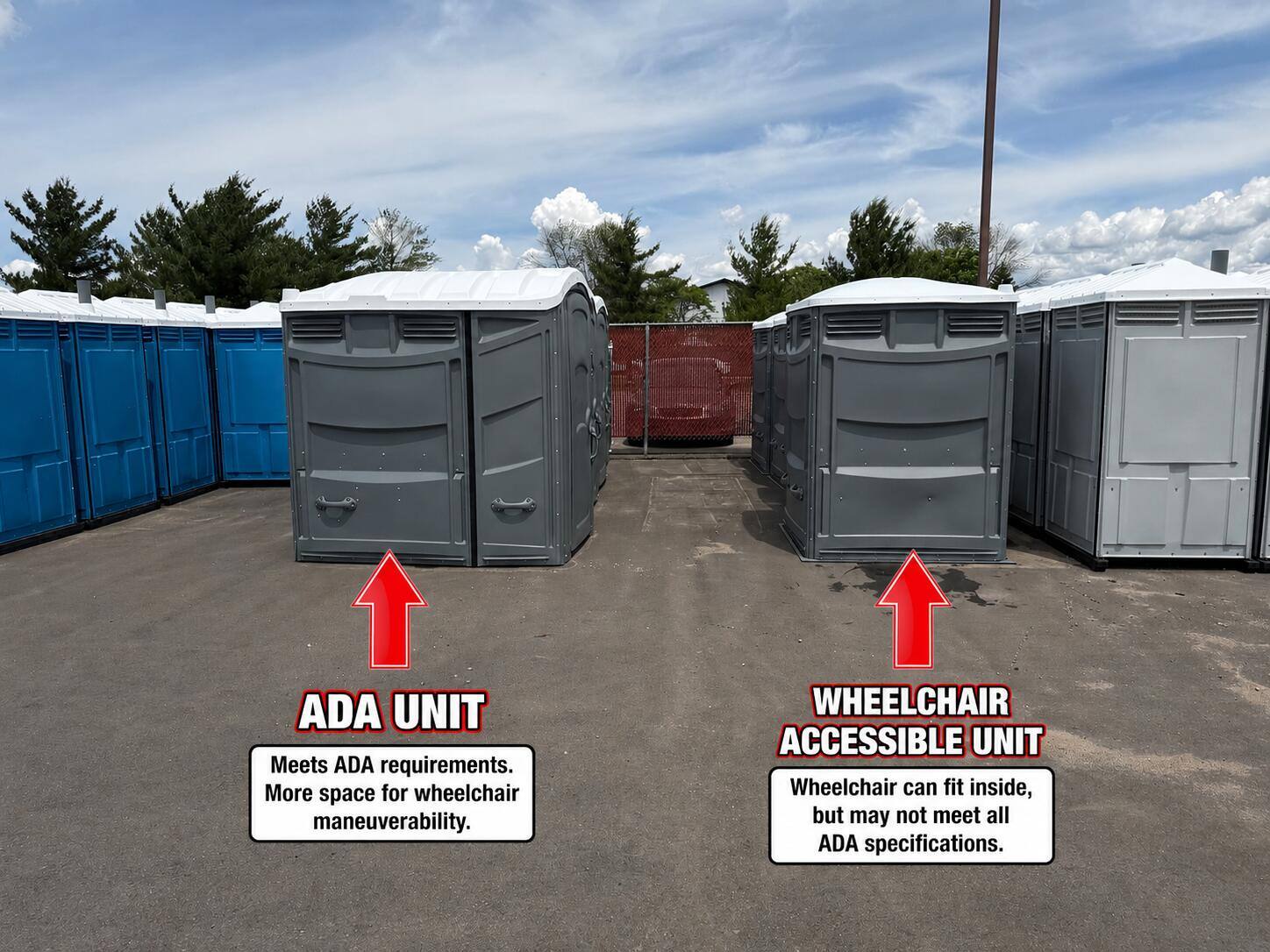
Side-by-side comparison
| ADA unit | Wheelchair-accessible unit | |
|---|---|---|
| Meets ADA requirements | Yes | Not necessarily |
| Ground-level entry | Yes | Usually |
| Wheelchair turning space inside | Yes | Limited |
| Grab bars | Yes | Varies |
| Right choice for public events | Yes | May not satisfy requirements |
How many accessible units are required?
The 2010 ADA Standards for Accessible Design address portable toilets in clusters: where multiple single-user portable toilets are clustered at a single location, at least 5% of them, but no fewer than one, must be accessible.
| Units in a cluster | Minimum ADA units |
|---|---|
| 1–20 | 1 |
| 21–40 | 2 |
| 41–60 | 3 |
| 61–80 | 4 |
If an event has restrooms in several locations, each cluster needs its own accessible unit.
Placement matters too
An ADA unit only helps if people can reach it. Place accessible units on firm, level ground along an accessible route, ideally at the end of the row nearest the path, not behind other units or on soft ground.
Frequently asked questions
Is a wheelchair-accessible porta potty the same as ADA compliant?
No. A wheelchair-accessible unit fits a wheelchair, but an ADA unit meets the full ADA requirements, including interior turning space.
How many ADA porta potties do I need for an event?
At least 5% of the units in each cluster, and never fewer than one per cluster, under the 2010 ADA Standards.
Do private events need ADA units?
Requirements focus on public events and facilities, but an ADA unit is a good idea for any event with older guests or guests with mobility needs.